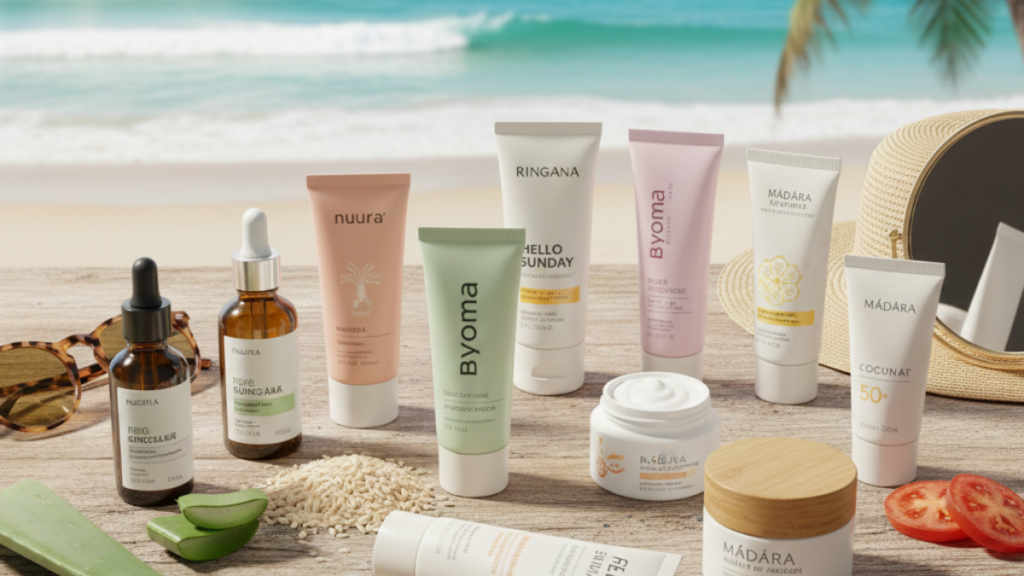
Are you looking for the ultimate vegan sunscreens? I have tried the top 10 that leave no white residue, truly protect your skin, and respect the ocean. The most honest, ethical, and complete guide of 2026.
If there is one thing I have learned in all these years of taking care of my skin, it is that having a ten-step routine is useless if the last step (the most important one) falters. Surely it has happened to you: you find the cream of your dreams, but when you go to check the sunscreen, you encounter pasty formulas, white streaks that make you look like a mime, or, worse, the doubt whether that brand really respects animal life.
In my case, I need every product that touches my face to be aligned with my values. I have spent months researching, testing under the sun, and analyzing every label to bring you the top 10. There is no “greenwashing” here or fine print, just real protection, incredible textures, and non-negotiable animal ethics.
- The importance of conscious photoprotection: more than avoiding a sunburn
- The science of light: What really happens to your skin under the sun?
- The art of reading labels: How to Spot Fake Vegan Claims
- Photoprotection and Nutrition: The reinforcement that comes from within
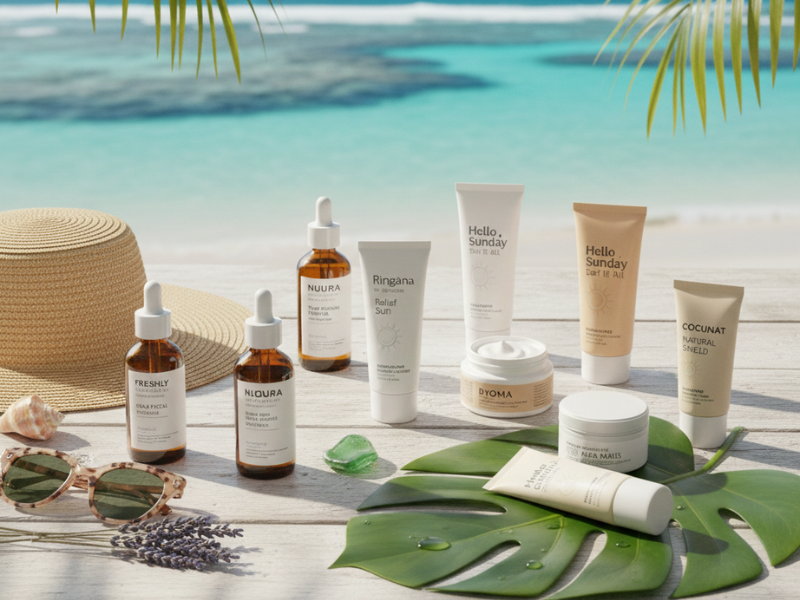
- The Top 10 Vegan Sunscreens
- 1. Freshly Cosmetics: Solar Facial SPF 50
- 2. Nuura: Solar Facial Fluid SPF 50
- 3. Hello Sunday: The One That's Got It All SPF 50
- 4. Beauty of Joseon: Relief Sun Rice + Probiotics
- 5. Ringana: FRESH sunscreen SPF 20
- 6. Mádara: Plant Stem Cell Antioxidant Sunscreen SPF 30
- 7. Byoma: Moisturizing Rich Cream SPF 30
- 8. Pai Skincare: British Summer Time SPF 30
- 9. Laboratories of Biarritz: Alga Maris SPF 50+ Children
- 10. Cocunat: Natural Shield SPF 30
- The golden rule: How to apply sunscreen so that it really works?
- Step-by-step guide for an expert vegan sunscreen application (The "Solar Layering" method)
- The sun doesn't go on vacation: why your shield should be annual
- Why specifically choose vegan options? Much more than a label
- Debunking the myths of the sun: what no one tells you (or tells you wrong)
- Photopollution: the invisible challenge
- Solar 'Skinimalism': less is more, but better
- The skin, the hormones, and the sun: a dance that we must lead
- Frequently Asked Questions about Vegan Sunscreen
- Can I use the body protector on my face?
- What does the circle around the letters UVA on my bottle mean?
- How do I reapply sunscreen if I am wearing makeup?
- Does vegan sunscreen expire if I don't open it?
- Do children need a higher SPF than adults?
- What is the difference between 'Cruelty-free' and 'Vegan'?
- Will I get a tan if I use SPF 50?
- Does sunscreen pollute the shower water?
- Should I put on sunscreen if I'm only going out to walk the dog for 10 minutes?
- What is the best time to apply it?
- How to read this table to get it right:
- The sun is life, enjoy it with awareness
This post contains affiliate links
The importance of conscious photoprotection: more than avoiding a sunburn
Sometimes we see sunscreen as a heavy obligation, but for me it is the greatest act of self-love you can have with your skin. The sun is wonderful, that’s clear, it gives us vitamin D and joy, but its radiation is responsible for 80% of premature aging. If you want velvet-like skin in the long term, sunscreen is the best long-term investment you can make for your skin.
But being vegan adds a layer of complexity. We not only look for it not to contain animal-derived ingredients (like beeswax or marine collagen, so common in traditional brands), but we demand that there was no suffering in any phase of its creation. Furthermore, we can no longer ignore the impact on the oceans. Every time we bathe in the sea, we leave a trace. That’s why all the selections on this list are “reef friendly,” protecting the corals while protecting your nose.
Mineral filters vs. modern synthetic filters: the dilemma of vegan sunscreen
In the world of natural and vegan cosmetics, we usually find two types of shields. Mineral (physical) filters are the favorites of bio cosmetics, because they act like mirrors. In the past they were a nightmare because no one could spread them evenly, but the brands I’m going to show you have achieved textures that feel like silk.
On the other hand, we have organic (chemical) filters of the new generation that are completely vegan and much more respectful of the body than those from ten years ago. The key here is transparency. In this top 10, I have included the best of both worlds so that, whatever your skin type, you can find your ideal match.
The science of light: What really happens to your skin under the sun?
To understand why we become obsessed with protection, we need to look under the microscope. Our skin has memory, and every ray it absorbs without protection goes straight to the “ledger” of our cells.
UVB rays are the ones that give us that tan we love so much, but they are also the ones that cause sunburn. They are short-wave rays that stay in the epidermis. But the real protagonists of this story are the UVA rays. These long-wave rays penetrate deep into the dermis, where collagen and elastin live. Imagine that collagen is a new and shiny spring; well, UVA acts like rust that makes it rigid and breaks it. The result is sagging and deep wrinkles.
But beware, now we have a new guest at the party: the Blue Light (HEV). It doesn’t come from the sun, but from your mobile, your tablet and the monitor from which you may be reading this. Blue light generates free radicals in a very similar way to the sun, causing what we call “digital aging”. That’s why, in the list of favorites I’ve prepared for you, I’ve prioritized brands that include specific shields against this light. Protecting yourself on the sofa at home is no longer crazy, using a vegan sunscreen at home is a necessity of modern life.
The art of reading labels: How to Spot Fake Vegan Claims
Sometimes we go into a store and see a green container with a leaf drawn on it and think: ‘This is for me!’. Wrong. Marketing is very clever, but you are going to be smarter. For a protector to be truly vegan and of ‘smooth skin’ quality, there are certain names we must learn to identify on the INCI (ingredients) list.
1. The ‘Villains’ we don’t want to see
- Beeswax / Cera Alba: very common for giving consistency, but it is an animal product. Look for vegan sunscreen options that use candelilla or carnauba wax.
- Lanolin: comes from the wool of sheep. It is very moisturizing, yes, but there are vegetable alternatives such as olive squalane, which do the same job without bothering anyone.
- Chitin: sometimes it is used as a thickener and comes from the shell of crustaceans.
- Carmine: if your vegan sunscreen has a pink tone or is a tinted stick, make sure it doesn’t use this pigment that comes from crushing insects.
2. The filters that yes, and those that no
If you are looking for an option that is also Reef Friendly, stay away from Oxybenzone and Octinoxate. They are not only suspected of being endocrine disruptors in humans, but they are also deadly to marine life. Instead, look for Zinc Oxide or Titanium Dioxide (physical filters), or modern organic filters like Tinosorb S or Uvinul T 150, which are safe, stable, and vegan.
Photoprotection and Nutrition: The reinforcement that comes from within
It’s not just what you wear, but how you nourish yourself. Did you know you can prepare your skin to receive the sun from your kitchen?
A diet rich in beta-carotene (carrots, pumpkin, sweet potato) and lycopene (cooked tomato, watermelon) helps your cells have a higher basal resistance to oxidation. They do not replace sunscreen, not even close, but they act as a support team. The antioxidants you eat neutralize part of the damage that UV rays try to cause to your face. A green smoothie loaded with spinach and berries before going to the beach is the perfect complement to your vegan sunscreen from Freshly or Nuura.
The Top 10 Vegan Sunscreens
Let’s get down to business. I have classified these products by their effectiveness, their ethics, and, of course, by how they leave the skin.
1. Freshly Cosmetics: Solar Facial SPF 50
This Spanish brand is the queen of my vanity for its own merits. Its vegan facial sunscreen is an ode to natural technology. What I like most is that it uses physical filters that do not leave the face white, thanks to its incredible formulation with cranberry and aloe vera.
- Why you are going to love it: it hydrates without greasing and has a citrus scent that awakens your senses in the morning. It is 100% vegan and its glass packaging is a bonus for the planet.
- Ideal for: daily city use and skin that seeks an extra boost of antioxidants.
2. Nuura: Solar Facial Fluid SPF 50
If you are passionate about the sea and surfing, or simply spend a lot of time outdoors, Nuura has to be on your radar. It is a brand created by people who live the ocean, and that shows. Its formula is minimalist, very resistant, and with an environmental awareness that borders on perfection.
- Why you will love it: it is, probably, the most respectful marine life protector I have ever tried. Its texture is fluid and adapts great to the skin.
- Ideal for: athletes, beach lovers, and people with radical ecological awareness.
3. Hello Sunday: The One That’s Got It All SPF 50
Hello Sunday is the brand that has come to make vegan sunscreen ‘cool.’ This particular product is wonderful because it is a hybrid between treatment and protection. In addition to protecting against UVA and UVB, it defends you from blue light from screens and pollution.
- Why you are going to love it: it contains hyaluronic acid and vitamin C. It is completely transparent, which makes it perfect for any skin tone, without fear of a grayish trace.
- Ideal for: people who work in front of the computer and want a flawless “glow” finish.
4. Beauty of Joseon: Relief Sun Rice + Probiotics
Directly from South Korea, this sunscreen has gone viral for one reason: it doesn’t look like a vegan sunscreen. It is a light, nourishing, and soothing cream that feels like a hug for your face.
Why you will love it: rice extract and probiotics help keep the skin barrier strong. It is 100% vegan and cruelty-free, showing that K-Beauty can be ethical and effective at the same time.
Ideal for: sensitive or dry skin that needs comfort and a juicy finish.
I get it on YesStyle, but I have also seen it in online pharmacies and, almost certainly, it can be found on Amazon.
5. Ringana: FRESH sunscreen SPF 20
If you are looking for radical freshness, Ringana is your brand. They don’t have stock accumulated for months in a warehouse; they manufacture and ship. This sunscreen is purely mineral and uses an intelligent combination of vegetable oils (such as karanja oil) to enhance protection.
- Kid-friendly? Yes! It is one of the best options for the little ones. Since it contains no chemical filters or synthetic fragrances, it is extremely safe for their delicate skin and for babies from 6 months old.
- Why you will love it: It is water-resistant and leaves the skin with an incredible feeling of nourishment. That said, remember that it is SPF 20, ideal for everyday use or if you are not going to be under the most intense sun.
6. Mádara: Plant Stem Cell Antioxidant Sunscreen SPF 30
From Latvia comes this gem of organic cosmetics. Mádara uses plant stem cells from dragon’s head (a northern plant) to give an extra boost of antioxidants while protecting you from the sun.
- Suitable for children? Absolutely. Its texture is silky and melts so well that children will not mind wearing it. It is a very clean formula that respects the skin barrier of the whole family.
- Why you are going to love it: it is translucent. Forget that white mask effect, this vegan sunscreen adapts to the skin leaving a beautiful healthy glow.
7. Byoma: Moisturizing Rich Cream SPF 30
This brand has revolutionized skin barrier care with its tri-ceramide complexes. Its vegan sunscreen is, in fact, a powerful moisturizer with built-in protection.
- Suitable for children? Yes, although it is more focused on adult faces, its ingredients are safe. However, for very young children I always recommend more specific brands of physical sunscreens like Nuura or Ringana.
- Why you will love it: it has no fragrance or denatured alcohol, which makes it perfect if you have reactive or acne-prone skin.
8. Pai Skincare: British Summer Time SPF 30
- Suitable for children? Totally. It is dermatologically tested on skin with eczema and extreme sensitivity, so it is a fantastic option for little ones with atopic skin.
- Why you will love it: it is one of the most elegant mineral textures on the market. It does not feel heavy and works wonderfully under makeup.
9. Laboratories of Biarritz: Alga Maris SPF 50+ Children
Although they have an amazing adult line, their version for children is so good that many of us use it for ourselves. They use a red algae extract (Alga-Gorria), which is a super powerful antioxidant.
- Kid-friendly? It’s their specialty. It is designed for babies from 6 months, is hypoallergenic, and very water-resistant.
- Why you are going to love it: if you are looking for maximum protection (SPF 50+) with the highest ethical safety, this bottle cannot be missing from your beach bag.
10. Cocunat: Natural Shield SPF 30
We close with another success from Spanish toxin-free cosmetics. Cocunat has created a vegan sunscreen, which besides being vegan, has a touch of color that evens out the skin tone without looking like you are wearing makeup.
- Kid-friendly? For the body you could use it, but since it has that subtle ‘good complexion’ color effect, I recommend keeping it for yourself and using its colorless body version for the kids.
- Why you will love it: It’s the perfect 2-in-1 for rushed mornings. It protects, moisturizes, and instantly removes that sallow tone.
The golden rule: How to apply sunscreen so that it really works?
It’s no use buying the best vegan sunscreen in the world if then you put on ‘just a little drop to make the bottle last.’
The amount matters: for your face, use the two-finger rule. Two lines of product from the base of your fingers to the tip. That is the real amount your face needs.
Don’t forget your ears or neck: they are the big forgotten areas and where we accumulate the most sun damage.
Reapply every 2 hours: yes, I know, it’s a hassle. But sweat, friction, and the sun itself degrade the protection. If you are wearing makeup, use the Hello Sunday stick we saw before, or a sunscreen mist.
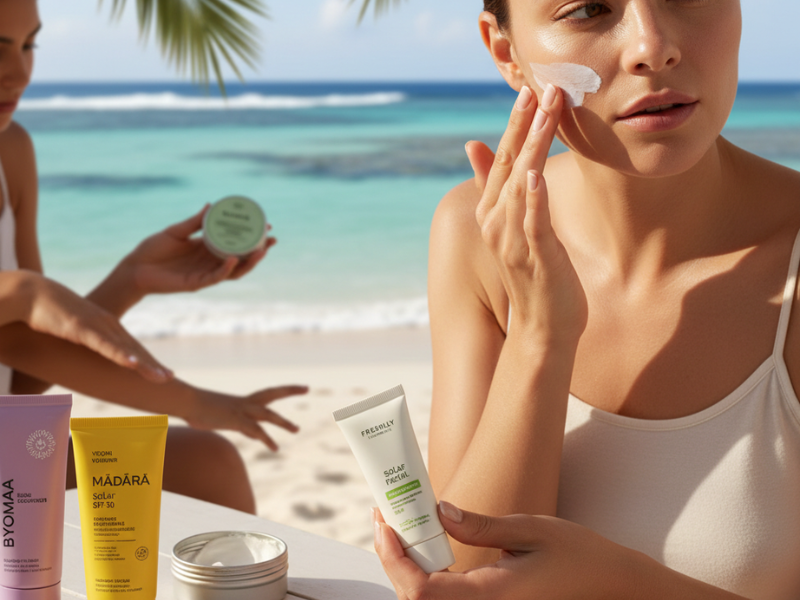
Step-by-step guide for an expert vegan sunscreen application (The “Solar Layering” method)
Step-by-step guide for an expert vegan sunscreen application (The “Solar Layering” method)
- light pre-moisturization: do not saturate the skin with a very dense cream before the sunscreen. If you use a moisturizing vegan sunscreen like the one from Beauty of Joseon, you might be able to skip the moisturizer and use only a hyaluronic acid serum.
- The technical wait: let your treatment products absorb for at least 2 or 3 minutes before applying the sunscreen. If the skin is ‘wet’ from serum, the sunscreen will not adhere properly.
- Application by zones: do not rub as if you were cleaning a glass. Spread gently and then give small taps with the palms of your hands to ‘set’ the product.
- The neck and the décolleté (Your true calling card): the face ends where the chest begins. Do not skimp there, because the décolleté is the area that most reveals sun damage over the years.
The sun doesn’t go on vacation: why your shield should be annual
We often make the mistake of thinking that vegan sunscreen is like sandals or a swimsuit: something we only take out of the closet when the heat hits. But let me tell you something that completely changed my skin: the sun doesn’t take days off. Even if the sky is gray in the middle of November or you’re watching the rain through your office window, the radiation is still there, working silently.
I’m not telling you this to make you panic, far from it. It’s about understanding the light calmly. There are two types of rays that interest us: UVB, which are the ones that burn and we associate with summer, and UVA, which are present with the same intensity all year round. The latter are the ‘silent thieves’ of collagen, passing through clouds and glass, and are responsible for the skin losing that smooth texture we so like.
Adopting the habit of protecting yourself every morning, no matter what the weather is like outside, is the cheapest and most effective beauty treatment there is. It is not fear, it is intelligence and preventive care. It is telling your skin: ‘I love you and I protect you every day, not just when it is 30 degrees.’
Why specifically choose vegan options? Much more than a label
If you are here, it is because you know that beauty cannot be complete if it leaves a trail of suffering behind. But why is it so vital to look for the vegan seal on sunscreens?
1. Coherence and animal ethics
Many conventional sunscreens use ingredients like beeswax to give consistency, or wool derivatives (lanolin) to moisturize. But the most critical point is animal testing. I believe that no cream is worth more than the life or freedom of a living being. Choosing a vegan sunscreen is assuring that your self-care has not cost anyone’s well-being.
2. Ingredients your skin recognizes
Vegan and natural sun care products usually replace paraffins and silicones (petroleum derivatives) with first-pressed vegetable oils, botanical butters, and plant extracts. These ingredients not only create a barrier against the sun, but also nourish your skin. Instead of ‘suffocating’ the pore with plastics, you provide it with essential fatty acids and vitamins that keep it elastic and hydrated.
3. Commitment to the ocean (Reef Friendly)
We cannot forget that what we put on our skin ends up, sooner or later, in the water. Next-generation vegan sunscreens are usually at the forefront of sustainability, eliminating chemical filters that bleach corals and harm marine life. It is a way to take care of your personal ecosystem while respecting the global ecosystem.
At the end of the day, choosing a vegan sunscreen is an extension of who you are. It is a powerful decision that shows you can shine, protect yourself, and be radiant without leaving a negative footprint on the planet. It is, simply, beauty with soul.
Debunking the myths of the sun: what no one tells you (or tells you wrong)
Sometimes, the greatest enemy of our skin is not the sun, but misinformation. We have grown up hearing phrases that we repeat like mantras, but in full 2026, science and ethical cosmetics have completely made them obsolete. Let’s dot the i’s with calm but with firmness.
Myth 1: “If I use SPF 50, I am protected all day”
This is the most common mistake and the one that causes the most sunburns. The sun protection factor (SPF) number does not indicate how long you can be in the sun absolutely, but how long it takes for your skin to burn compared to if you were wearing nothing.
But there is a problem: sweat, clothing friction, wind, or simply touching your skin with your hands degrade the protective layer. After two hours, that SPF 50 is no longer a 50. That is why I will always tell you that reapplication is the key. If you are in the office away from a window, you can stretch it a little longer, but if you are outdoors, reapplication every two hours is non-negotiable.
Myth 2: “Crystals protect me from everything”
I wish it were so, but physics is capricious. Glass in your home, car, or office blocks most UVB rays (the ones that burn), but they let through almost all UVA rays (the ones that age).
If you’re working near a bright window, you’re getting a constant dose of silent radiation that degrades your elastin. That’s why my routine always includes vegan sunscreen, even if my Saturday plan is couch, blanket, and reading. Your skin doesn’t know you’re covered, it just feels the energy going through it.
Myth 3: “Dark or already tanned skin doesn’t need cream”
This myth is dangerous. It is true that skin with more melanin has somewhat greater natural protection (equivalent to an SPF of about 13), but that does not make it immune to cellular damage or skin cancer.
A tan is, in reality, a cry for help from your skin. It is the way it tells you: “I am being attacked and I am going to make a dark shield to protect myself.” Being tanned does not mean you are no longer being harmed, it means the damage has already begun. All skin types, from the palest to the darkest, need their shield of vegan sunscreen to stay healthy.
Myth 4: “Sunscreen prevents you from making Vitamin D”
This is the favorite argument of those who hate creams. The reality is that to synthesize the necessary daily dose of Vitamin D, it is enough to expose small areas of your body (like your arms or legs) to the sun for 10 or 15 minutes, three times a week. You don’t need to scorch your face. In addition, no sunscreen blocks 100% of radiation; enough always gets through for your body to perform its biochemical magic without compromising the health of your face.
Photopollution: the invisible challenge
Nowadays, our skin not only faces the sun. We live immersed in a sea of artificial radiation.
Have you heard of the exposome? It is the set of external factors to which we are exposed daily: pollution, tobacco smoke, stress, lack of sleep, and of course, radiation. When the sun mixes with city pollution, a devastating cocktail effect occurs. Pollution particles stick to your skin and, under UV light, oxidize, causing a silent inflammation that accelerates spots.
That is why looking for vegan sunscreens that are rich in antioxidants (like Mádara’s with stem cells or Freshly’s with astaxanthin) is so important. They not only act as a wall, but also as a cleaning team that neutralizes those free radicals before they cause harm.
Solar ‘Skinimalism’: less is more, but better
I know that sometimes you feel overwhelmed with so many steps. The current trend is skinimalism: using few products but ones that are very effective and multifunctional.
If your morning routine feels like a chore, look for products that do it all. A good current vegan sunscreen usually includes:
Hydration: hyaluronic acid or plant ceramides.
Treatment: vitamin C, E, or botanical extracts.
Protection: safe physical or chemical filters.
By choosing one of the 10 I have recommended, you save steps. You can cleanse your face, apply your sunscreen, and you’re done! You don’t need to complicate your life to have healthy skin. The key is the quality of the ingredients and consistency, not the number of bottles you have in the cabinet.
The skin, the hormones, and the sun: a dance that we must lead
Our skin is not a static entity, it is a living organ that reacts to our hormonal dance. We know that you don’t need the same vegan sunscreen at 20 as at 50, nor does your skin behave the same during pregnancy or a busy menstrual cycle. Understanding this is what gives you true power over your complexion.
1. The challenge of pregnancy and breastfeeding: beware of melasma
During pregnancy, our hormones (specifically estrogens) are at very high levels, which activates melanocytes. This is when the famous “chloasma” or pregnancy mask usually appears: those dark spots on the forehead and upper lip.
Advice: here, vegan physical (mineral) sunscreens are your best friends. Since they are not absorbed into the bloodstream, they are 100% safe for the baby and, by acting as a physical shield, they are more effective at blocking the heat that sometimes activates the spots. Brands like Nuura or Laboratoires de Biarritz are your winning bet at this stage.
2. Menopause and maturity: when the sun ‘drinks’ from your hydration
With the drop in estrogen, the skin becomes thinner, drier, and loses its ability to retain water. The sun at this stage not only causes spots but also dehydrates aggressively.
Look for rich and oily textures. The vegan sunscreen from Ringana or the one from Byoma (with its ceramides) help replenish the lipid barrier while protecting you. You need photoprotectors that feel like a nourishing night cream.
3. Hormonal acne in your 30s: don’t let the sun fool you
Sometimes, we think that the sun ‘dries’ pimples. It’s an illusion. The sun thickens the outer layer of the skin (hyperkeratosis) and, when the tan fades, the pores are more clogged than ever, causing a rebound autumn breakout.
Use lightweight formulas with soothing ingredients like rice or the probiotics in Beauty of Joseon’s vegan sunscreen. They protect you without adding weight to skin that is already struggling with its own internal processes.
Frequently Asked Questions about Vegan Sunscreen
Can I use the body protector on my face?
You can, but I do not recommend it. The skin on the face has more sebaceous glands and is thinner. Body sunscreens are usually denser and could cause comedones (blackheads) or uncomfortable shine. If you want soft skin, use products specific for each area.
What does the circle around the letters UVA on my bottle mean?
It is a European regulation. It means that protection against UVA rays is at least one third of UVB protection (the SPF number). If it doesn’t have the circle, run away. It is not protecting you from aging.
How do I reapply sunscreen if I am wearing makeup?
It’s the million-dollar question. You have three great vegan options: transparent sticks (like the one from Hello Sunday), sun mists that are sprayed over makeup, or mineral powders with SPF. There are no excuses for not touching up.
Does vegan sunscreen expire if I don’t open it?
Normally, unopened cosmetics have a shelf life of 30 months. However, always check the expiration date if it has one. Once opened, strictly follow the PAO symbol (the open jar).
Do children need a higher SPF than adults?
It’s not that they need a higher number (a 50 is a 50 for everyone), but that they need formulas with physical filters and without fragrances, since their skin is much more permeable and sensitive to chemicals.
What is the difference between ‘Cruelty-free’ and ‘Vegan’?
“Cruelty-free” means that the final product and its ingredients have not been tested on animals. “Vegan” means that it does not contain any ingredients of animal origin. A product can be one thing and not the other. In this list, all the products are both things.
Will I get a tan if I use SPF 50?
Yes, you will tan, but in a slower, safer, and longer-lasting way. The tan without burning lasts much longer because the skin does not have to ‘peel’ to regenerate after the damage.
Does sunscreen pollute the shower water?
Everything we put on ourselves ends up in the water system. That is why choosing brands with biodegradable ingredients and without microplastics (like those in this ranking) is essential to reduce our water footprint.
Should I put on sunscreen if I’m only going out to walk the dog for 10 minutes?
Yes. Sun damage is cumulative. Those 10 minutes a day turn into 60 hours of sun per year without protection. Your skin is built through small daily habits.
What is the best time to apply it?
Ideally, it is 15-20 minutes before leaving the house so that the filters (especially if they are new generation chemical ones) settle and create the uniform protective film on your skin.
| Brand & Product | SPF | Filter Type | Best For… | Suitable for Children? | Ethical Highlight |
|---|---|---|---|---|---|
| Freshly Cosmetics | 50 | Mineral (Physical) | Daily wear and city life | Yes | 100% vegan and packaged in glass. |
| Nuura Fluid | 50 | Mineral (Physical) | Sports and beach activities | Yes | Plastic-free and strongly reef-friendly. |
| Hello Sunday | 50 | Chemical (Vegan) | Office workers and blue-light exposure | Not recommended | Invisible finish with hyaluronic acid. |
| Beauty of Joseon | 50 | Chemical (Vegan) | Dry skin and K-Beauty lovers | Not recommended | Nourishing formula with rice extract. |
| Ringana FRESH | 20 | Mineral (Physical) | Sensitive skin and organic skincare enthusiasts | Ideal | Fresh cosmetics made to order. |
| Mádara Antioxidant | 30 | Mineral (Physical) | Anti-aging and radiance | Yes | Enriched with Northern plant stem cells. |
| Byoma Rich Cream | 30 | Chemical (Vegan) | Compromised skin barrier | Yes | Fragrance-free and rich in ceramides. |
| Pai British Summer | 30 | Mineral (Physical) | Highly sensitive skin | Ideal | Tested on eczema-prone skin. |
| Laboratoires Biarritz | 50+ | Mineral (Physical) | Maximum sun protection | Ideal | Hypoallergenic and highly water-resistant. |
| Cocunat Natural Shield | 30 | Mineral (Physical) | Healthy glow (“good skin day” effect) | Body use only | Tinted formula with no controversial ingredients. |
How to read this table to get it right:
- If you are looking for extreme comfort: Choose Hello Sunday or Beauty of Joseon. They are textures that seem like magic and don’t leave any white residue.
- If you are a mom and looking for a single jar for everyone: Go for Pai, Nuura, or Laboratoires de Biarritz. They are the safest for kids’ skin and the most respectful of the planet.
- If you are concerned about the passage of time: Mádara and Freshly are your allies due to their high antioxidant content that fights wrinkles while protecting you.
- If you have very reactive skin: Pai Skincare is, without a doubt, your safe harbor.
The sun is life, enjoy it with awareness
Taking care of your skin shouldn’t be a source of stress, but a ritual of gratitude toward the body that allows you to live, feel, and enjoy the light. By choosing vegan and ethical options, you are sending a message to the world that your beauty doesn’t need to come at anyone else’s expense.
I hope this giant guide serves as a compass for you in 2026. Remember that consistency is the secret ingredient that doesn’t come in any bottle. Protect yourself, shine, and maintain the healthy, glowing skin you work so hard to care for
Now it’s your turn: Which of these sunscreens has stolen your heart? Do you have any questions we haven’t answered?
Write to me in the comments, I love reading your messages and learning from your own experiences. See you in the next post!